


How to Choose a Compact Travel Buggy: What Matters Most
A compact travel buggy should make getting around a lot easier, not give you another thing to wrestle with. It folds smaller, weighs less, and is especially handy for car boots, public transport, or overhead lockers on flights. But a buggy still needs to cope once you’re off the smooth airport floor and back to pushing on uneven pavements in town, or across a school field. Here’s a look at what actually matters, what’s worth checking twice, and the questions parents tend to ask before they buy a compact travel buggy.
What is a compact travel buggy?
A compact travel buggy is a lightweight pushchair that folds down smaller than a standard pram, making it easier to carry, store, and travel with. Most are designed for car boots, public transport, travelling abroad, and tighter spaces at home. They typically weigh between 5 kg to 9 kg, with some suitable from birth using a near-flat seat, carrycot, or car seat adaptors, and others from 6 months to around 4 years of age.
Compared with a full-size pushchair or travel system, compact models usually have a smaller frame, a lighter build, and a simpler, faster fold mechanism. Umbrella strollers are simpler and lighter, but many compact buggies offer more comfort, storage, sun cover, and everyday features. All-terrain and jogging buggies are different again, with bigger wheels and stronger frames for rougher ground or running.
In its 2026 review of compact folding pushchairs, MadeForMums describes a compact buggy as “one that folds down small enough to be stored in tight spaces, to travel on planes, or to fit into the boot of a small car”. That is the basic idea. The best choice depends on how you travel, where you store your buggy, and how often you’ll use it.
What should you look for in a compact travel buggy?
Folded size and weight are usually the first things parents check when buying a compact travel buggy. Fair enough, they matter. But the wheels, recline, fold, comfort, storage, and push feel can make just as much difference once you start using it. Here are ten things worth checking before you choose.
Folded dimensions and cabin compatibility
If you plan to fly, the folded size decides whether the buggy goes in the overhead locker or down to the hold. The general benchmark is the IATA carry-on guidance of 56 x 45 x 25 cm, including wheels and handles.
UK airlines vary, though. EasyJet, Jet2 and British Airways align with those dimensions for the larger cabin bag. Our own Nipper Compact buggy meets that size too. Packed into its included travel backpack, it measures 55 x 25 x 35 cm. Ryanair’s free cabin bag is smaller, at around 40 x 30 x 20 cm. Still, we’ve had our Compact in the cabin on a Ryanair flight. TUI is tighter again at 55 x 40 x 20 cm.
It’s worth knowing that “cabin approved” is a marketing label, not a guaranteed cabin spot. Even when a buggy fits the dimensions, gate staff can ask for it to go in the hold on busy flights. Every UK airline lets you check a buggy into the hold free of charge. So the choice is usually between cabin if you’re lucky, hold if you’re not.

Weight, and why ultra-light isn't always better
Most compact buggies sit between 5 and 9 kg. Under 7 kg is often classed as lightweight, while anything around 6 kg or less can feel very easy to lift, carry, or take onto public transport.
Lightweight travel buggies can be handy, especially if you need to carry one up stairs or through a station. The trade-off is that very low weights can mean smaller wheels, less suspension, or a lighter frame. That may not matter for short trips, but it can affect comfort, handling, and durability if you use the buggy often.
A slightly heavier compact buggy can still be travel-friendly if it folds well and feels easy to manage. Rather than chasing the lowest number on the spec sheet, look at how the buggy carries, folds, steers, and handles the places you’ll actually use it. Our own Nipper Compact sits at 8.9kg for this reason. Light enough to lift onto a train or carry up stairs, but not so stripped-back that it loses decent wheels and suspension that make it comfortable day to day.
Wheel type: air, foam, or puncture-proof
Buggy wheels make a bigger difference than most parents expect, especially once you leave smooth pavements. Air-filled (pneumatic) tyres tend to give the softest ride because they absorb bumps better, which is why they’re often used on jogging and all-terrain pushchairs. The downside is that they can puncture just like bike tyres, and may need pumping up from time to time.
Foam-filled or ETPU puncture-proof wheels give a ride close to air-filled but without the maintenance. They're ideal for travel because they won't go flat in the hold. EVA or plastic-foam wheels are lighter and cheaper, which helps keep the buggy compact. They’re fine on smooth surfaces, but they can feel firmer and bouncier on cobbles, up kerbs, or over grass. Grip is limited too.
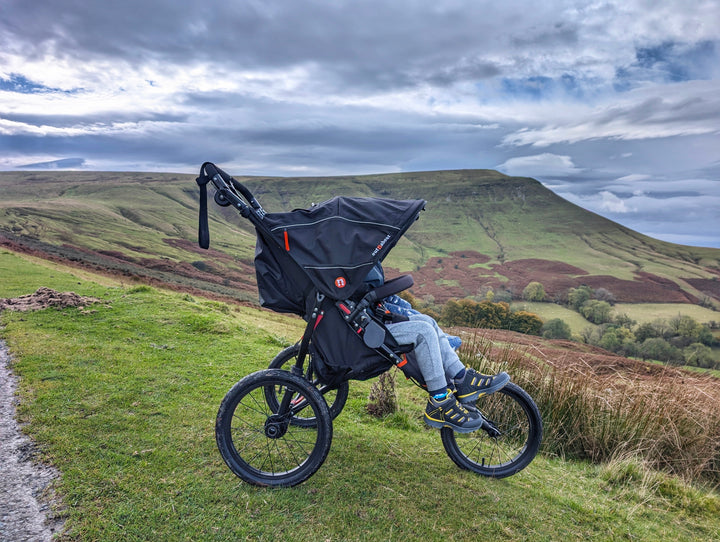
Wheel size matters too. Larger wheels usually cope better with uneven ground, while smaller wheels help keep the fold tight. Neither is automatically better, but it’s worth thinking about where you’ll push your buggy most often before choosing. It's the balance we aimed for with our own Nipper Compact buggy, which has larger 14-inch ETPU Magic Wheels for uneven ground while still folding small for travel.
Suspension and ride comfort
Suspension can add weight and bulk, so some compact buggies keep it minimal to stay lighter and easier to fold. That can help with carrying and storage, but the ride may feel firmer on uneven ground.
Without suspension, more bumps travel through the frame, which can mean a rougher ride for your child and more effort for you when pushing. Suspension is one of the main reasons a compact buggy can or can’t double as your everyday buggy. If you live in a city, use parks often, or want something that can handle light off-road use, you may want to prioritise suspension. It’s the reason we built suspension into the Nipper Compact rather than stripping it out to shave weight, so it still copes with kerbs, cobbles and grass rather than only smooth floors.
From-birth suitability and recline
For safe newborn use, a compact travel buggy needs either a near-flat recline, close to 180 degrees, carrycot option, or infant car seat compatibility. Some compact buggies are marketed as “from birth”, but don’t fully lie flat. That matters because newborns can’t yet support their head properly.
Check the exact recline angle, not just the “from birth” wording. If you want true lie-flat use, check whether the brand offers a compatible carrycot or newborn travel system option before you buy.
Fold mechanism
A one-hand fold matters when you’re holding a baby, carrying bags, or dealing with luggage. It should feel simple and fold quickly. Travel buggies that self-stand after folding are useful too, especially in train carriages, airport queues, or anywhere you need the buggy upright and out of the way.
Check that the buggy locks shut once folded, can be carried easily, fits into a travel bag, and reaches its smallest fold without too much faff. Some compact buggies need the seat or wheels removed first, so make sure the advertised dimensions are clear about what stays attached or not.
Travel system compatibility
A compact buggy that works with a carrycot or car seat adaptors can be used from birth as a full travel system. That means you may not need to buy a separate first pram.
It’s worth checking which car seat brands the adaptors fit before you choose. A buggy with wider car seat compatibility is usually more practical than one that only works with a limited range.
Build quality and durability
Pushchairs deal with plenty, from rough ground to daily folding and lifting. That is where build quality matters, especially with compact travel buggies designed to stay lighter and smaller.
Look for a sturdy frame, durable fabric, solid wheels, and a fold mechanism that locks cleanly. A buggy that lasts across two or three children, and still has decent resale value, can be a better long-term buy than one you end up replacing.
Running and jogging capability
Most compact buggies are not certified for running, even if they feel light and easy to push. The Out 'n' About Nipper Compact is one of the exceptions. If you want to jog with a compact travel buggy, check that it is designed and tested for running like ours, and not just everyday walking.
The UK standard for running buggies is BS EN 1888-3:2024. Under this certification, sport use is only recommended with children aged at least 9 months or over, so always check the manufacturer’s guidance before running with any buggy.
A running buggy usually needs a lockable front wheel, handlebar brake, and wheels big enough to stay steady over uneven ground. Our own Nipper Compact travel buggy ticks all three.
Push experience and manoeuvrability
A buggy can feel very different in a shop compared with daily use. Smooth floors and an empty seat do not tell you much about how it will push once there is a little one onboard, a bag underneath, or a less perfect surface under the wheels.
Three-wheel buggies tend to turn more easily in tight spaces, while four-wheel buggies can feel more planted at speed. If you can, test a buggy with some weight added, and try it somewhere less polished than a showroom floor.

When is a compact travel buggy the right choice?
For many families, a compact travel buggy suits city living, frequent flying, public transport, small storage, or active days out where you need to move quickly. It’s also a sensible second buggy for families with a full-size pushchair at home but a need for something lighter on trips.
It’s less likely to suit families who need the maximum storage and newborn padding of a full-size pram, or a buggy built mainly for serious off-road use. If you want to run, choose a compact travel buggy only if it is properly tested and certified for sport use.
In 2026, the strongest compact travel buggies are no longer just tiny strollers for airport floors. The best ones are small enough for travel, but still sturdy enough for regular use. For many families, that can mean buying one buggy that covers more jobs, rather than two separate ones.
A compact buggy built to do more
Choosing a compact buggy often means compromising on wheel size, suspension, newborn options or everyday capability. The Nipper Compact was designed to bring more of those features together.
It weighs 8.9kg, folds with one hand, stands independently and packs into an included travel backpack measuring 55 × 25 × 35cm. Puncture-proof ETPU Magic Wheels and built-in suspension also help it handle cobbles, gravel, grass and uneven pavements.
The lie-flat seat is suitable from birth, with the option to add the parent-facing Nipper Pod or use a compatible infant car seat with adaptors. It is also certified for running from 9 months.
It suits city streets, public transport, small car boots, holidays, parks and lighter trails, while still offering the capability for everyday all-terrain use. For regular use on rougher ground, the Nipper V6 remains our everyday all-terrain workhorse, while the Nipper V6 Plus is better suited to more demanding terrain and serious running.
But for families who want one buggy that travels light without giving up everyday capability, the Nipper Compact was designed to do exactly that.
Final checks before you buy a travel buggy
Choosing well comes down to more than the smallest fold or the lowest weight. A good compact travel buggy should fit the way you move, whether that means flights, public transport, tight storage, quick errands, or days out where a bulky pram feels like too much.
Think about where you’ll push it most, how often you’ll fold it, and what your child needs for comfort. Once those bits are clear, it becomes much easier to choose a buggy that works beyond the first trip away.
For families who think they may need more off-road capability, our guide to all-terrain pushchairs from Out ’n’ About is a useful next read.
And if a compact that still handles real terrain sounds closer to the mark, meet the Nipper Compact, the travel-ready buggy for active city living.
Frequently asked questions
What's the difference between a compact stroller and a regular pushchair?
Regular pushchairs are usually larger, with more padding, bigger wheels, and extra features for everyday use. Compact strollers (or buggies) are smaller and lighter, with a fold designed for travel, public transport, and tighter storage.
How big is a compact travel buggy when it is folded?
Most compact travel buggies fold to around 50 to 60 cm long, 25 to 35 cm tall, and 20 to 30 cm deep. Smaller models may fit within the 56 x 45 x 25 cm cabin bag benchmark. Always check the exact folded size and whether the measurement includes the seat and wheels.
Do compact buggies fit in aeroplane overhead lockers?
Some compact buggies fold small enough for aeroplane overhead lockers, usually around 56 x 45 x 25 cm. Most UK airlines, including easyJet, Jet2 and British Airways, allow this when there is space. Cabin space is not guaranteed, though, and gate staff can still ask for the buggy to go in the hold.
Can a compact buggy be used from birth?
Yes, some compact buggies can be used from birth, but only with the correct newborn setup. That usually means a near-flat recline, close to 180 degrees, a carrycot, or infant car seat compatibility. Always check how the buggy supports newborns before relying on “from birth” wording.
Are buggies allowed on public transport like trains and the underground?
Buggies are allowed on UK trains and the London Underground at all times. No booking is needed. On trains, use designated wheelchair or pram spaces where available. On the Underground, step-free stations make travel easier. Folding the buggy can help on busy services.
Can a compact travel buggy handle any terrain?
With the right design, a compact travel buggy can handle more than smooth pavements. Look for suitable wheel size, proper suspension, and a sturdy frame, such as on our Nipper Compact, if you’ll be pushing over parks, cobbles, kerbs, grass, or light off-road ground. For tougher countryside routes, an all-terrain buggy may still be the better fit.
How light is a compact travel buggy?
Most compact travel buggies weigh between 5 and 9 kg. Anything under 7 kg is usually considered lightweight, while the lightest models sit closer to 5 kg. Very low weight can be useful for travel, but it may also mean smaller wheels, lighter frames, or less suspension.
Can a compact travel buggy be used as your main, everyday buggy?
Yes, a well-built compact travel buggy like the Nipper Compact can be used as your main everyday buggy. Look for proper suspension, suitable wheel size, a comfortable seat, a strong fold mechanism, and enough storage for regular use. The best option depends on where you push, how often you travel, and what your child needs.

